
The key number: 30318 — the Westside Atlanta zip code now home to a celebrity fashion brand.
Cardi B's newly launched fashion collection, Bardi Style, is not based in New York. Not in Los Angeles. Not in her native Washington Heights.
The company's headquarters is in Atlanta.
The announcement, buried in a Delaware incorporation filing and confirmed by sources close to the launch, places the brand's operations, logistics, and design studio in Atlanta's Westside district — the same neighborhood housing A Ma Maniére, a growing crop of direct-to-consumer labels, and multiple fashion incubators.
Here is the business analysis of why Atlanta won this deal and what it means for the city's fashion ambitions.
What We Know About Bardi Style
Detail | Information |
|---|---|
Brand name | Bardi Style |
Founder | Cardi B (Belcalis Almánzar) |
Headquarters | Atlanta, GA (Westside, zip code 30318) |
Legal entity | Bardi Style Group LLC (filed in Delaware, operational address in Atlanta) |
Launch date | Fall 2026 (announced, specific date TBD) |
Category | Contemporary women's wear, accessories, footwear |
Price range | 48–48–298 (based on trademark filings and job postings) |
Key hires | Operations lead (hired), design director (hired), logistics coordinator (open) |
The brand has been in development for 14 months. According to trademark applications, Bardi Style will cover clothing, handbags, belts, footwear, and hair accessories. The price point targets the "accessible luxury" gap — above fast fashion, below designer.
But the location decision is the most interesting business signal.
Why Atlanta, Not New York or LA?
Most celebrity fashion brands follow a predictable geography:
New York for editorial access and supply chain proximity (garment district)
Los Angeles for manufacturing speed and influencer ecosystems
Milan/Paris for luxury credibility
Atlanta offers none of those traditional advantages. So why did Cardi B's team choose it?
Cost structure
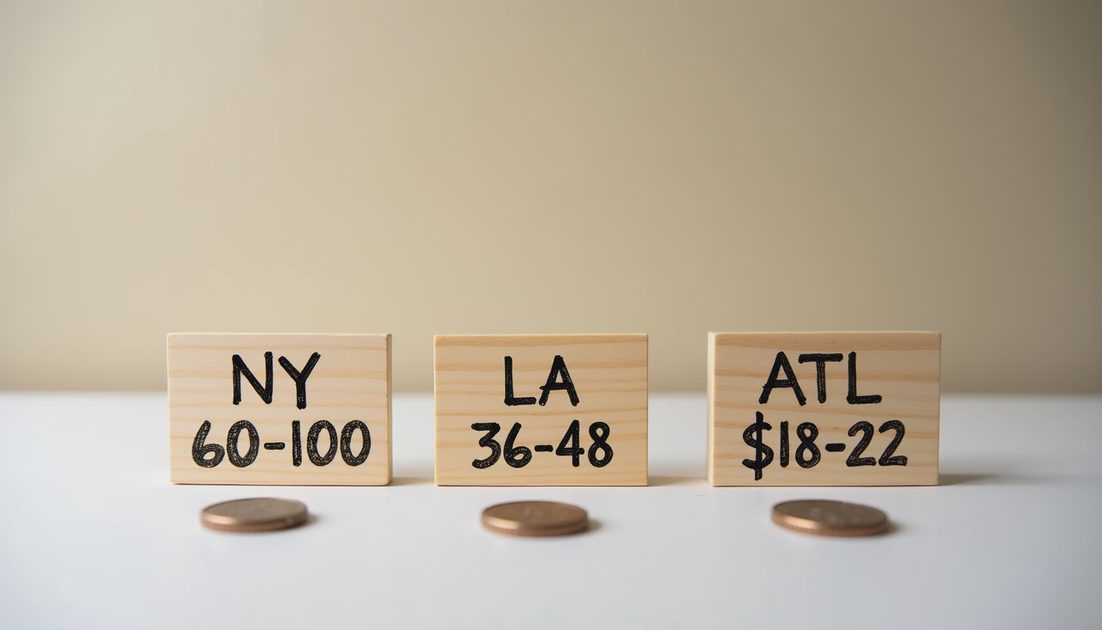
A 5,000-square-foot warehouse and studio space in Atlanta's Westside costs roughly $18–$22 per square foot annually. Comparable space in Manhattan's Fashion District runs $60–$100. In LA's Fashion District: $36–$48.
For a brand launching at scale — Bardi Style is expected to carry 80–100 SKUs at launch — lower fixed costs mean more runway. The brand can afford to hold more inventory, test more products, and take longer to find product-market fit.
Logistics and distribution
Atlanta is a freight hub. Hartsfield-Jackson Atlanta International Airport handles more cargo than any other airport in the world. The city sits at the intersection of three major interstate highways (I-20, I-75, I-85), giving Bardi Style two-day ground shipping to 60 percent of the US population.
For a direct-to-consumer brand, that is a competitive advantage. Faster shipping, lower costs, and less reliance on third-party logistics providers.
Talent without the premium
Celebrity brands need operations people — warehouse managers, production coordinators, quality control leads. In New York or LA, those salaries come with a 30–40 percent premium for the same skill set. In Atlanta, the same talent exists (thanks to a growing logistics and apparel manufacturing sector) but at lower cost.
Bardi Style's posted logistics coordinator role: $55,000–$70,000. A comparable role in New York: $75,000–$95,000.
Tax incentives
Georgia offers a number of incentives for distribution and warehousing operations, including job tax credits for creating positions in certain census tracts. The Westside qualifies. While Georgia is not offering the scale of production tax credits that attract film and TV, the logistics incentives are real and quantifiable.
Celebrity adjacency without celebrity chaos
This is the least-discussed factor but possibly the most important.
Cardi B can operate in Atlanta with less paparazzi attention than in New York or LA. The city's celebrity ecosystem is robust enough to provide creative collaborators (musicians, stylists, producers) but diffuse enough that a brand headquarters can function without daily spectacle. That matters when you are trying to hire normal operations people who need to get work done.
The Risks and Skepticism
Not everything about this decision is a win. Here is what gives us pause.
Risk 1: The talent gap for design
Atlanta has strong operations and logistics talent. It has fewer senior-level fashion designers, pattern makers, and technical designers. Bardi Style's design director was hired from New York and will likely need to commute or relocate. If the brand scales to multiple seasonal collections per year, the lack of a deep local design talent pool could become a bottleneck.
Risk 2: Sample making and prototyping
New York and LA have same-week sample rooms. Atlanta does not — not yet. Bardi Style will either need to fly samples in from New York (adding time and cost) or build its own in-house sample room (adding fixed cost). Either way, the brand will move slower than a New York-based competitor on design iteration.
Risk 3: Celebrity brand failure rate
The celebrity fashion graveyard is full. From Fetish (Selena Gomez) to William Rast (Justin Timberlake), most celebrity lines fail within three years. The causes are consistent: low quality, overpricing, lack of designer involvement, or some combination.
Cardi B has been publicly involved in Bardi Style's development — she attended fabric sourcing meetings in person — but sustained attention is difficult for any celebrity with a music career, touring schedule, and family obligations. If her involvement fades, so will consumer interest.
Risk 4: Atlanta's retail infrastructure
Bardi Style is launching as direct-to-consumer, but successful contemporary brands eventually need wholesale partners. Atlanta is not a wholesale hub. The city has limited buying office presence compared to New York. That means Bardi Style's sales team will likely need to be based elsewhere or travel constantly during market weeks.
What This Means for Atlanta's Fashion Ecosystem
This is the bigger picture.
A Cardi B fashion brand headquartered in Atlanta is not, by itself, transformative. One brand does not make a district.
But it is a signal. Here is what that signal says:
Signal 1: Atlanta is now on the map for brand headquarters. Not just satellite offices or pop-ups. Actual headquarters. That matters for future deal flow. When the next celebrity or independent designer asks "where should we base the company," Atlanta now has a case study.
Signal 2: Logistics and cost are winning arguments. Atlanta did not win this deal because of its fashion week or its creative energy. It won because the math worked. Cheaper space, faster shipping, lower salaries. That is not glamorous, but it is durable.
Signal 3: The Westside continues to consolidate. A Ma Maniére, Stride Theory, Haven ATL, and now Bardi Style — all within a two-mile radius. That is not a district yet, but it is a cluster. Clusters attract more clusters.
What We Are Watching
Atlanta Fashion Report will track the following over the next 12 months:
Metric | Why It Matters |
|---|---|
First drop sell-through rate | Indicates whether Cardi B's audience converts to paying customers |
Second collection timeline | Speed to second drop signals operational maturity |
Local hiring numbers | How many of the first 20 employees are Atlanta-based |
Warehouse location | If they outgrow Westside space quickly, that is a good sign |
Wholesale conversations | First retailer partnership (if any) will signal trade confidence |
We will also follow up on whether the brand builds in-house sample-making capacity or continues to rely on New York vendors.
The Bottom Line
Cardi B's decision to headquarter Bardi Style in Atlanta is not charity. It is not a hometown loyalty play — she has no direct ties to the city. It is a cold business calculation driven by cost, logistics, and operational sanity.
That makes it more meaningful than a vanity project.
The risks are real: design talent gaps, slower sample turnaround, and the long shadow of failed celebrity brands. But if Bardi Style succeeds — even moderately — it will validate Atlanta as a legitimate headquarters city for fashion brands at scale.
That is a story worth watching.