
Hypebeast published three pieces explicitly focused on Atlanta's streetwear scene during the past month. That is not nothing. But for a city that positions itself as a primary engine of street culture — alongside New York, Los Angeles, and Tokyo — the number raises a question.
Is Atlanta getting the coverage it deserves? Or is the gap between influence and ink simply how national media works?
Let us look at what ran, what did not, and what the silence says about Atlanta's media problem.
What Hypebeast Actually Published This Month
We reviewed every Hypebeast story published between March 15 and April 15. Here are the three Atlanta-focused pieces:
1. "A Ma Maniére's Latest Jordan Collaboration Breaks Down the 'While You Were Sleeping' Campaign" — A standard product release story. Solid reporting. But it focused entirely on the sneaker, not on how A Ma Maniére operates as an Atlanta business.
2. "Summer Walker's Stylist Breaks Down Her Tour Wardrobe" — A celebrity streetwear feature. Atlanta gets mentioned as the singer's home base, but the story's lens is national, not local.
3. "Inside the Atlanta Pop-Up Where Vintage Meets Tech" — A 600-word feature on a one-weekend-only event in the Westside. This was the closest Hypebeast came to treating Atlanta as an ecosystem rather than a backdrop.
That is it. Three stories. No designer profiles. No retail analysis. No coverage of Atlanta Fashion Week planning. No reporting on the wholesale deals moving through the city. No look at the incubators or funding announcements.
What Hypebeast covered this month: sneakers, a celebrity tie-in, and a pop-up.
What Hypebeast did not cover: everything else.
The Gap: Influence vs. Ink
Here is the tension.
Atlanta's streetwear influence is undeniable. The city's artists — Future, Gunna, Latto, and a generation of underground acts — have shaped baggy silhouettes, accessories styling, and the blend of luxury and workwear that defines current streetwear. Sneaker culture runs through Atlanta like few other cities. A Ma Maniére alone has redefined how collaborations work.
But influence is not the same as coverage.
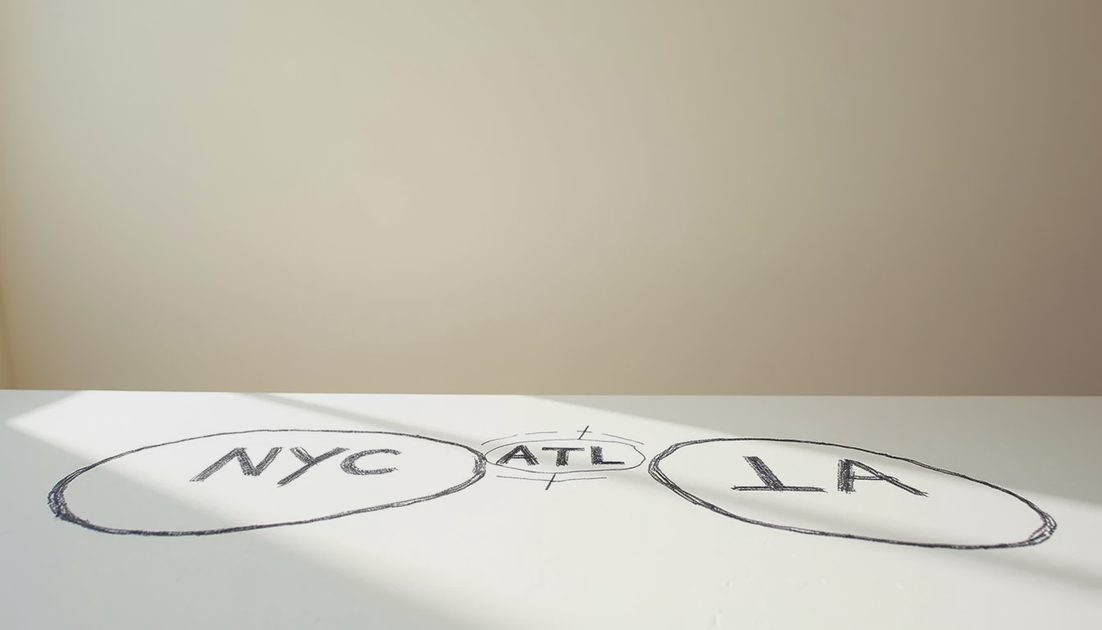
National streetwear media operates on a hub-and-spoke model. New York and Los Angeles are the hubs. Everything else is a spoke — visited when there is a story, then abandoned until the next event. Tokyo gets hub treatment because of its established fashion week infrastructure. London and Paris get hub treatment because luxury media has roots there.
Atlanta sits in a middle tier. Important enough to assign a photographer for a sneaker release. Not important enough to station a reporter.
Hypebeast's three stories this month reflect that tiering. They are not ignoring Atlanta. They are covering Atlanta exactly as much as their editorial model allows: reactively, not proactively.
What Gets Lost in That Model
When a national outlet covers Atlanta only through product releases and celebrity adjacencies, three things disappear:
1. The business stories. Who raised money. Who signed a wholesale deal. Who is hiring. These are not sexy, but they are how a fashion ecosystem matures. Hypebeast did not cover Haven ATL's $400K pre-seed round. That is a streetwear story with a balance sheet. It went untold.
2. The infrastructure. Atlanta has sampling studios, pattern makers, and small-batch manufacturers that streetwear brands depend on. Hypebeast has never profiled a single one. Without infrastructure coverage, readers see the finished product but not the supply chain that makes it possible.
3. The long arc. A designer's third collection matters more than their first. A brand's second year of profitability matters more than its launch. But national media chases newness. That leaves brands in their growth phase invisible — precisely when they need coverage most.
Is That Unfair? Or Just Reality?
Here is where we land.
Hypebeast is not obligated to cover Atlanta. They are a business. Their audience is global. Their advertising revenue comes from brands that want reach, not regional depth.
But here is what their three-article month signals: Atlanta is still treated as a source of raw material — artists, styles, energy — rather than a destination for serious fashion journalism.
The city produces the culture. New York and Los Angeles get to interpret it. That dynamic benefits nobody except the media companies that get to parachute in, take what they need, and leave.
What would change it? Two things. First, more Atlanta brands reaching national scale — not just cool, but commercially undeniable. Second, a local publication like this one filling the gap until the national outlets realize they have been missing half the story.
The Bottom Line
Three Hypebeast stories in a month is not a slight. It is a symptom.
The original reporting on Atlanta streetwear will continue to come from national outlets when big sneaker releases happen or when a celebrity wears something interesting. That is their model. It works for them.
But what they leave out — the funding rounds, the infrastructure, the long-term brand building — is not being covered anywhere else.
That is why this publication exists.