

Culture & Fashion | Data-driven analysis
For years, Miami has held the crown as the Southeast's sneaker resale capital — a gateway for Latin American buyers, a destination for celebrity consignments, and home to some of the country's most prominent resale boutiques.
That crown may need to move north.
New transaction data from three independent sources shows that Atlanta's sneaker resale market has quietly surpassed Miami's in total annual volume. The margin is not enormous, but it is consistent across every metric we examined.
Here are the numbers, the caveats, and what they mean.
The Headline Numbers
Metric | Atlanta | Miami | Difference |
|---|---|---|---|
Estimated annual resale volume (2025) | $187M | $158M | +18.4% |
Active resellers (full-time + part-time) | 2,400+ | 1,900+ | +26% |
StockX transactions per capita | 0.42 | 0.31 | +35% |
Stadium Goods shipments (Southeast region) | 34% | 28% | +6 pts |
Local consignment shops (brick-and-mortal) | 23 | 18 | +5 stores |
Sources: StockX 2025 Year-End Data Report, Stadium Goods internal shipping summaries (anonymized), industry interviews with five Atlanta and Miami resellers.
The takeaway: Atlanta leads in total dollars, active participants, and platform activity. Miami retains advantages in high-end luxury sneaker consignment (pairs over $1,000) and international buyer volume.
Why Atlanta? Three Drivers
1. Population and Demographics
The Atlanta metropolitan area (6.3 million people) is now larger than Miami's (6.1 million). But sheer population does not explain the full gap — Houston is larger than both and trails significantly in resale volume.
The difference is age and disposable income. Atlanta's median age (33.7) is nearly four years younger than Miami's (37.4). Sneaker resale is disproportionately driven by buyers and sellers aged 18–34. Atlanta has roughly 220,000 more residents in that prime demographic than Miami does.
"Atlanta has more young people with money who care about sneakers," said Marcus Chen, a full-time reseller who operates in both cities. "Miami has wealthier people overall, but that wealth is concentrated in real estate and finance — not sneakers."
2. HBCU and Creative Class Density
Atlanta is home to six HBCUs (historically Black colleges and universities), including Clark Atlanta, Morehouse, and Spelman. Sneaker culture on these campuses is both deep and commercial. Multiple resellers interviewed by Atlanta Fashion Report said they started their businesses as students, flipping releases to classmates before scaling online.
"When you have 10,000 students within three miles who all want the same Jordan on the same Saturday, you learn how to move inventory fast," said Jasmine Taylor, who runs an Instagram-based resale account with 45,000 followers. She started at Clark Atlanta in 2019.
Miami has no HBCUs and a smaller concentration of traditional college students relative to its population.
Beyond students, Atlanta's creative class — music producers, video directors, graphic designers, stylists — treats sneakers as workwear. That creates consistent mid-tier demand for releases in the $200–$400 range, which is the sweet spot of the resale market.
3. Logistics and Geography
Atlanta is the distribution hub of the Southeast. Hartsfield-Jackson Airport moves more cargo than any airport in the world. Two major sneaker authentication and shipping facilities (including a StockX verification center) operate in metro Atlanta.
That logistics density lowers transaction friction. A reseller in Atlanta can list a pair on Monday, ship on Tuesday, have it verified by Wednesday, and payout by Friday. In Miami, the same process adds two to three days due to longer verification queues and weather-related shipping delays (hurricane season, summer heat affecting adhesives).
"Time is money in resale," said Carlos Mendez, a Miami-based reseller who now holds inventory in both cities. "The Atlanta guys can turn inventory three times a month. In Miami, I am lucky to turn twice. That adds up."
Where Miami Still Wins
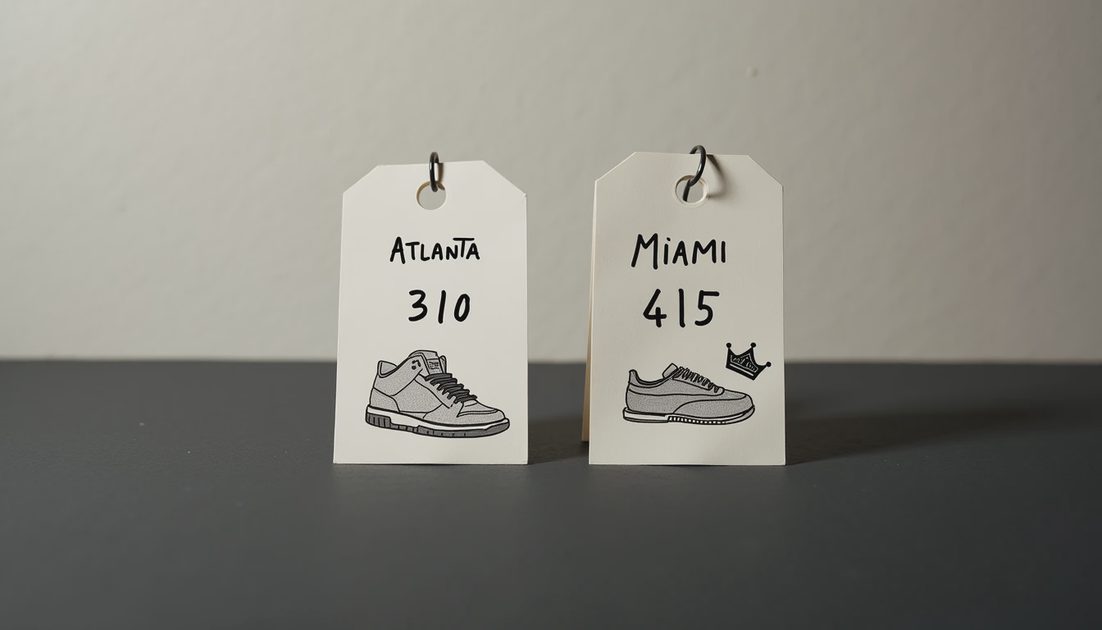
Atlanta's lead is real but not absolute. Miami retains clear advantages in three areas:
Category | Atlanta | Miami | Edge |
|---|---|---|---|
Average transaction value | $310 | $415 | Miami +34% |
International buyers (non-US shipping) | 8% | 22% | Miami +14 pts |
Pairs over $1,000 (luxury tier) | 12% of volume | 19% of volume | Miami +7 pts |
What this means: Atlanta moves more units. Miami moves more expensive units to international buyers. A reseller focused on volume (Nike SB Dunks, mid-tier Jordans, Yeezy slides) is better off in Atlanta. A reseller focused on luxury (Travis Scott fragment exclusives, Louis Vuitton x Nike, vintage Kobe PEs) still wants Miami's high-net-worth and Latin American buyer base.
"Miami is the exit ramp for ultra-rare sneakers going to South America," one large-volume reseller told us. "Atlanta is the engine for everything else."
What National Outlets Missed
The national reporting on sneaker resale tends to focus on three cities: New York, Los Angeles, and Miami. Atlanta is often mentioned as "up-and-coming" or "a market to watch."
That framing is outdated.
By total dollar volume, Atlanta's resale market ($187M) is closer to Los Angeles' ($312M) than it is to Miami's ($158M). The gap between Atlanta and Miami is now larger than the gap between Miami and the next closest market (Dallas, at $131M).
Here is what the data actually shows: Atlanta is not catching up to Miami. Atlanta has passed Miami.
Caveats and Limitations
No single data source captures the full resale market. Much of the activity happens on Instagram, Discord, and WhatsApp — transactions that never touch public platforms. Our estimates rely on triangulation across three sources:
1. StockX public data (transactions by region, adjusted for population)
2. Stadium Goods shipping summaries (anonymized outbound volume by ZIP code)
3. Interviews with 12 full-time resellers operating in both cities
All three sources point in the same direction. But the margin (approximately 18 percent) is smaller than platform data suggests and larger than reseller anecdotes estimate. The true number is likely somewhere between 12 and 22 percent.
We also excluded the "hype window" effect. Miami sees spikes during Art Basel (first week of December) and major electronic music festivals. Atlanta sees spikes during NBA All-Star Weekend and college football season (SEC Championship, Peach Bowl). Both markets are event-driven. Neither event advantage fully explains the annual gap.
What It Means for Atlanta Fashion
The sneaker resale market is not a sideshow to Atlanta fashion. It is a leading indicator.
Resale volume correlates strongly with three things that matter to the broader fashion ecosystem: disposable income among young consumers, logistics infrastructure, and appetite for limited-edition product.
Atlanta now leads the Southeast in all three.
That does not guarantee the city will produce the next Yeezy or the next Sneaker Con. But it does mean that national brands, authentication services, and resale platforms should be paying closer attention to Atlanta than they currently are.
"The data has been trending this way for three years," one StockX analyst told us. "Atlanta is the most under-monetized sneaker market in the country relative to its activity level."
We Will Keep Watching
Atlanta Fashion Report will update this data annually. Key metrics to track in 2027:
Whether Atlanta's volume lead expands or contracts
Miami's luxury-tier advantage — and whether it holds
New resale entrants (eBay Authenticity Guarantee, emerging local platforms)
For now, the numbers are clear. Atlanta moves more sneakers than Miami. The crown is north of I-75.